
Selected client work
Real marketing problems, better systems behind them
Client work led by Katie Lendel. Three businesses, three different constraints, one job: find what is actually stuck and build the system around it.
 Written by Katie Lendel,Founder & Strategic Marketing Lead
Real estate technology
About Time Tours
Turning a tour coordination tool into a brand made for busy agents

The problem
About Time Tours helps buyer's agents organize the showing day: the homes each buyer picked, the tour plan, time changes and the feedback afterwards. It is available in supported South Florida and Oregon markets.
The product did real work for buyer's agents, but it needed a brand and a website that showed that work at a glance.
What Katie handled
The logo, the brand identity and the messaging, then the website design, the page copy and the blog articles. The brand and the site lead with the agent's day, not the software's feature list: each page follows one part of that day, from building the tour to what each buyer thought of it.
Software features. A showing day agents recognize.
Helped with: app design and flow, the marketing tools in the admin
What changed
About Time Tours now has a brand and a full website built around the agent's showing day. Agents, teams and brokerages each have their own way in, the blog gives agents practical reading on the showing day, and every page ends at the same next step: a guided setup.
- A new brand
- A site for agents, teams and brokerages
- One clear next step
Evidence
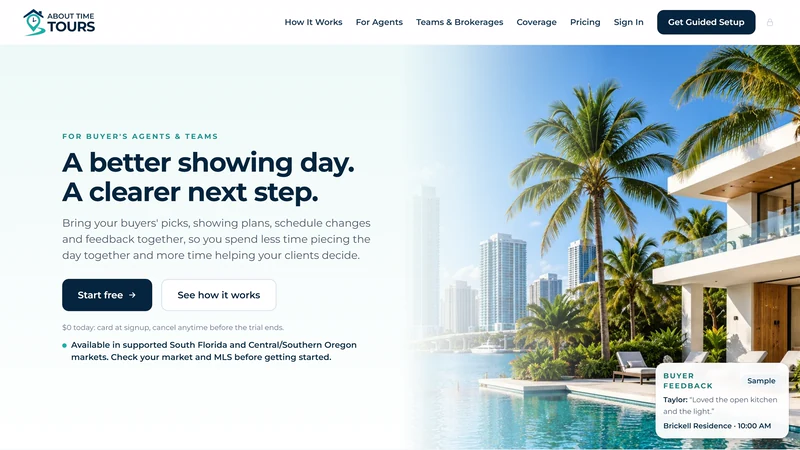
- Screenshot of the live site: The abouttimetours.com homepage, shown with this story. Captured September 2026.
- Katie's account of her role: The brand, the website, the page copy and the blog, with a hand in the app. As reported by Katie, September 2026.
- Not claimed: No client quote is published for this story, and no traffic, lead or sales figures.
Software and technology
Suntek Solutions
Turning complex technology into a story buyers could understand

The problem
Suntek had deep technical capability across software and custom development. Buyers had to decode what the company did before they could see why it mattered to them.
What Katie handled
Positioning and messaging that start from the business problem the technology solves, and what changes for the customer because the company exists, with the technical concepts translated rather than stripped out. Then the search-led educational content, the social media and the content strategy behind both, all on the same message.
Complex service. Clearer story.
Katie also rebuilt and extended Suntek's referral partner program, so an introduction from someone who knows the company can turn into recurring income for them.
What changed
The message moved from what the technology is to the problem it solves. Educational search content gives buyers a way to understand Suntek before they start a conversation, and social runs on the same footing, so the message holds wherever they meet it.
The partner program page states the terms plainly. Partners share ready-made links for each landing page, every referral is tracked to the right person, and nobody earns until Suntek approves them. Each partner has a portal of their own: their referrals, a snapshot of what they have earned and what recurs each month, an earnings calculator, a guided first visit and a marketing kit with social graphics, captions, email introductions and a one-page overview. Suntek's team has one screen to approve partners and record closed deals, client payments and payouts.
- Clearer positioning
- Buyer-friendly messaging
- Search-led education
- A rebuilt partner program
Evidence
Katie has been an invaluable extension of the Suntek Solutions team. She created ScaleLounge specifically to give businesses a more organized way to manage their marketing, strategy, content, and projects all in one place. It makes collaboration easier for both Katie and our team and gives us greater visibility into everything being worked on. It truly changes the game for businesses that want better marketing without the chaos of managing it all themselves.
- Client quote, shared with permission: Scott V.'s words above, word for word, given with permission to share and on this site since August 2026.
- The partner program's own code: The program described above is taken from the code of Suntek's partner program, September 2026. Its screens are not shown here.
- Katie's account of her role: The positioning, the messaging, the search content and the social. As reported by Katie, August 2026. The rebuild of the partner program, as reported by Katie, September 2026.
- Not claimed: No traffic, lead or revenue figures.
Disclosure: Suntek Solutions also provides the hosting behind ScaleLounge's website.
Residential real estate
AddressUSA
Turning one idea into a marketing system that kept working

- The problem
- Every piece of content started from nothing, which made marketing harder to keep up.
- What changed
- Content got built around shared ideas instead of three separate activities.
160+ search articles, each with the social and email that went with it
Read the full story
The situation
AddressUSA needed to stay visible consistently. Content was produced piece by piece, each one starting from nothing, which made marketing steadily harder to maintain.
The strategic shift
Instead of blog, email and social as three separate activities, content got built around shared ideas. One useful topic became a search article, an email and several social posts.
One idea. Multiple channels. More value from the same work.
What we handled
The business impact
Over 160 search articles were produced, and each one carried the social content and the email that went with it. One topic, planned once, arriving everywhere the audience already was.
Marketing became easier to maintain, and search-focused content gave good ideas a longer life, so people could find the company well after the original publishing date.
- 160+ search articles
- Social and email with every one
- One idea, multiple assets
Good content strategy is not about producing more. It is about building a system where every strong idea works harder.
The pattern
Different businesses, the same underlying problem
The deliverables were different. The strategic job was the same: understand the real constraint, build the right marketing system around it, and make execution easier to sustain.
Real estate technology
We need agents to see what the product does at a glance.
Software and technology
We need customers to understand why our expertise matters.
Residential real estate
We need to stay visible without constantly creating from scratch.
Marketing works better when someone owns the whole picture.
About this work
These are selected client engagements led by Katie Lendel, Founder and Strategic Marketing Lead. Some were completed before the ScaleLounge brand existed; the strategic thinking and execution behind them is what ScaleLounge is now built on.
The About Time Tours and Suntek Solutions stories list their evidence: what it is and when it is from. The AddressUSA story, including the count of search articles, is as reported by Katie.
The outcomes described are qualitative. Where a number appears it counts work delivered, not performance: no traffic, lead or revenue figures are claimed.
Before you decide
ScaleLounge against the alternatives
Hiring a marketing manager
When does an employee fit the job better than an outside partnership?
See the comparison ScaleLounge vsA traditional agency
What needs a specialist team, and what needs one accountable partner?
See the comparison ScaleLounge vsA fractional CMO
Leadership for an existing team, or leadership plus hands-on execution?
See the comparisonAbout to hire? Before you hire a marketing manager
Your next chapter
Your problem probably looks different
It does not need to match. The job is the same: find where it is stuck, and work out what needs owning.
